Distress Tolerance (Prepare for Stormy Weather)
Distress Tolerance skills are what brought me to DBT in the first place. I need to develop skills and strategies to help me when I’m overwhelmed by emotion.
“In these situations,” the authors advise, “we can’t think clearly and can’t use complex skills like Checking the Facts or Problem Solving. If you ever feel this way, you’ve reached what DBT calls the “skills breakdown point.” At this point, it’s really difficult to access Wise Mind.” Luckily, DBT has skills for these exact moments.”
These are “DBT crisis survival skills…designed to help you cope with intense distress without making things worse.”
Key provisos here – the skills covered in this chapter need to be practised to be effective, and it’s important to plan ahead for “emotional storms”. The authors call this chapter of the book a “guide to ‘emotional emergency’ preparations.”
There are a lot of steps to distress tolerance. I’ll try to unpack them.
Step one in a crisis: resist the urge to act impulsively (to change the situation) by using the STOP skills –
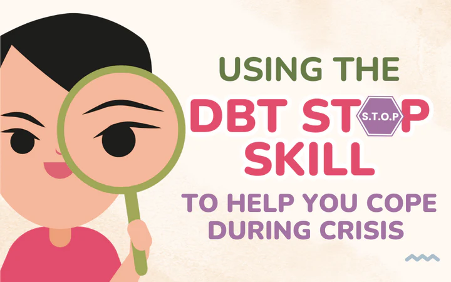
STOP
TAKE A STEP BACK
OBSERVE
PROCEED MINDFULLY
The authors advise that the easiest way to STOP is to use the separate skill of COPE AHEAD.
“The Cope Ahead skill involves identifying a potentially difficult situation, planning how to cope with it, and then imagining yourself using that plan to cope effectively. Research supports the idea that we can learn new skills by practicing them in our imagination, possibly because the same parts of the brain get activated whether we do a thing or think about doing that thing.”
Cope Ahead is looked at in a later exercise, and so the authors move on to three strategies that can be used to cope with distress. The assumption here is that we’ve used the STOP skill in our crisis, so we’re now left with the original distress. We haven’t made things any worse by our actions, but they’re also no better.
Enter 3 sets of DBT skills. Distraction is the first.
DISTRACTION
“Distraction involves purposefully bringing your attention away from the painful event that is prompting your emotions, and shifting it to something else more positive or neutral. Distraction can help you pass the time when your distressing problems can’t be solved right now.”
DBT likes its acronyms, and here’s one which lists various distraction options - ACCEPTS
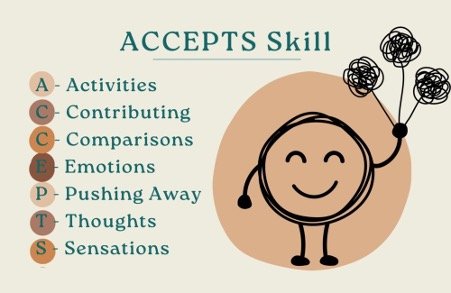
Activities: do something that takes your full attention.
Contributing: shift the focus from your problems to other people by volunteering or helping a friend.
Comparisons: compare yourself to someone who is worse off than you, or compare this crisis to one you got through.
Emotions: seek out emotions that aren’t the ones you’re currently feeling. “Watch a horror film when you’re sad, listen to comedy when you’re angry, or read a romance novel when you’re anxious.”
Pushing away: “ push away thoughts or feelings. Imagine putting the problem on a shelf, on the backburner, or behind a wall. Deny the situation, temporarily.”
Thoughts: this is where you sing a song, or do anything else that will fill your mind to “interrupt worry or rumination.”
Sensations: “ground yourself with physical sensations” by taking a cool shower, or eating hot food.
The second DBT skill for crisis survival is Self-Soothing.
SELF-SOOTHING
Self-soothing is “purposefully being soothing, nurturing, and physically kind to yourself when you’re distressed. To identify your self-soothing skills, consider what makes you feel pleasure, relaxed, happy, or soothed in each of the five senses.”
Examples (from the book) on each sense are below –
SIGHT: look at nature or art.
SMELL: brew strong coffee, burn a scented candle.
HEARING: listen to your favourite album.
TASTE: eat comfort food.
TOUCH: stroke a dog, pet a cat, find a cosy blanket.
The third crisis survival skill is IMPROVE THE MOMENT. This is one I like, and a skill I’m getting better at using.
“IMPROVE can be particularly handy when your current distress is from a situation that is longer lasting.”
Some IMPROVE examples are below –
Imagery: imagine acting skilfully, draw on positive memories from the past.
Meaning: look for the silver lining in any situation. Read inspiring stories of others’ triumphs.
Prayer: connection in the broadest sense, and it doesn’t need to be linked to religion. The aim here to tap into to something bigger than yourself by meditation, volunteering or getting out in nature.
Relaxing actions: anything relaxing like deep breathing or gentle movement.
One thing in the moment: “focus your entire attention on just this one moment to decrease worrying about the future or thinking about everything that has gone wrong in the past.”
Vacation: not necessarily a real holiday, it could be more like an afternoon nap, or a walk in the park. “Take a brief vacation from life (in any way that won’t cause you trouble!)”
Encouragement and rethinking the situation: replace self-criticism with positive self-talk. “Cheerlead yourself.”
Distraction, Self-Soothing and IMPROVE are helpful skills for getting through a crisis without making the situation worse. But the authors stress that they can’t be used indefinitely.
“The important thing here is that you eventually return to addressing the problem that caused the crisis in the first place, once you are no longer in Emotion Mind. While the crisis survival strategies can be helpful on a temporary basis, overusing them and avoiding distress entirely is likely to lead to crisis after crisis, because these strategies don’t address the actual problems causing your distress. Instead, think of these skills as helpful ways to get the break that everyone needs at times.”
This paragraph made me think about the repercussions of staying too long in a damaging relationship, or continuing to do something that’s clearly not very healthy.
Next up – Distress Tolerance Kits.