Work Through Emotional Blocks
“Often people come to DBT because they’re feeling emotionally stuck and looking for ways to get out of painful emotional loops.”
Yes, that’s me. So this chapter is about reducing emotions that I don’t want to feel (good luck with that) by learning two skills –
1) Checking the Facts
2) Opposite Action
The authors warn that these two are tough to use and challenging to master. If we can get to grips with them, however, we’ll have two of the most powerful tools the book can offer in our back pocket. Or rucksack, or wherever DBT tools are kept.

Here are the nuts and bolts of Checking the Facts –
1) “What we think about a prompting event can change how we feel about it, and how we feel can change what we’re thinking.”
2) The authors use the example of a friend not commenting on a haircut. I’m not sure this is a great example. In my experience people with a new haircut will be greeted by -
a) ‘I like your hair.’
b) ‘You’ve done something to your hair.’
0r (not spoken, but picked up via special thought waves) -
c) I can see that you’ve done something to your hair, but I don’t like it, and so I will say nothing.
Anyway, let’s assume that I’m very pleased with my new haircut, and I send a picture of it to my friend. She doesn’t reply for ages (later on she’ll say she just loves my new hair) but let’s imagine that in the hours before she replies I –
Curse her loudly
Cast her into the darkness
Send her a text saying ‘Lousy friend you are. You never notice me.”
And other accusations.
Which leads to a row.
When, in fact, she was always going to reply to my message except that she got stuck in a lift with a small horse, and no phone signal. Now she’s taken umbrage and won’t talk to me.
As the authors wisely say, “Acting as if our thoughts are facts can get us into trouble in a lot of ways.”
Checking the Facts may not always be necessary. Sometimes our thoughts about events are accurate. But in many cases, our emotional pain comes from an interpretation layered on to an event.
Checking the Facts involves
1) Imagining the widest range of perspectives possible.
2) Avoiding catastrophic thinking – ‘the world has ended or is about to’ – by increasing our ability to think more flexibly and accurately.
I’ve just done one of those meandering searches online for helpful video clips because writing about a self-help book in detail can feel very flat, and unsatisfactory. I found this by Marsha Linehan on Checking the Facts -
https://www.facebook.com/watch/?v=382752450357595
I also stumbled across a whole bunch of resources on a site called Borderliner Notes, including superb videos by psychoanalyst Peter Fonagy. Here’s one below on Checking the Facts –
And here’s a link to the whole site, which includes great video content from Linehan (inventor/creator of DBT), psychoanalysts Kernberg and Fonagy, psychiatrist Gunderson, and others.
https://www.youtube.com/channel/UC0RQwa3uLto4y2R8Eg1hKTg
There’s a treasure trove of resources here, and I plan to watch most of the videos. It will make a very welcome change from just reading books on DBT/BPD. And I discovered it by accident!
Borderliner Notes is also on Instagram.
Now, back to my more local struggles with the self-help book. It turns out I need more in my toolbox than just Checking the Facts. This is because there are going to be times when my interpretation of a situation will be accurate (imagine that), and so whatever emotion I feel will fit the facts. Or I’ll be in the sort of situation I can’t bear where I’ll never be able to establish whether my interpretation was bang on. There are further opportunities for distress here – I might feel pretty sure that my view of what’s happened is accurate, but I may still be bothered or preoccupied. This is where Opposite Action comes in.
CHANGE HOW YOU’RE ACTING TO CHANGE HOW YOU FEEL
“Opposite Action is acting opposite to an emotion’s action urges, which changes how you feel by interrupting the emotion’s self-loving cycle.”
Opposite Action is something I’ve got fairly good at, though my repertoire of actions is still fairly limited. Whenever upsetting things happen (I might feel very badly misunderstood, or I might start to worry that everything in my life is spiralling out of control), I try to go to the gym as soon as I can. Luckily for me, my gym is 5 minutes away, and open 24 hours a day.
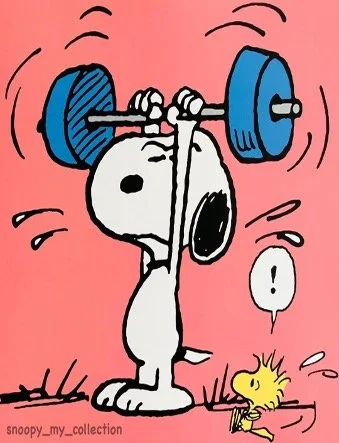
Here is Snoopy practising his Opposite Action of weightlifting when he might just feel like going back to bed because something in his day has really upset him.
And here’s a couple of examples of Opposite Action from the book –
EMOTION: Anxiety
EXAMPLE WAYS TO ACT OPPOSITE: Approach (rather than avoid), do what you’re afraid of doing, act confident, breathe slowly and deeply, talk animatedly
EMOTION: Anger
EXAMPLE WAYS TO ACT OPPOSITE: Do something nice for someone (rather than attack them), walk away or take a break (rather than fight), breathe slowly and deeply, relax your body, lower your voice.
To summarise – Opposite Action is a skill we can use to decrease unwanted emotions. It needs to be practised a lot to be effective. And, annoyingly, it may not always be that effective. En route to something else, I found this 2019 study online –
Isolating the Effect of Opposite Action in Borderline Personality Disorder: A Laboratory-based Alternating Treatment Design
https://www.ncbi.nlm.nih.gov/pmc/articles/PMC6467696/
The researchers found that Opposite Action is more effective for managing the emotions linked to sadness and shame/guilt, and less useful for anxiety and anger emotion states. It’s worth having a look at the whole study, but the clinicians’ conclusions roughly stated are –
1) Opposite Action may be effective for anxiety states in the long term (after repeated practice of the skill), and a one-off laboratory experiment is more likely to induce anxiety than reduce it.
2) People value the intensity of anger and will often try to maintain this state for longer as catharsis or validation.
I’ll wrap up here. Provisos aside, Opposite Action is worth trying, and finessing, and later exercises will require me to do just this.